- Igniting Innovation, Nurturing Futures
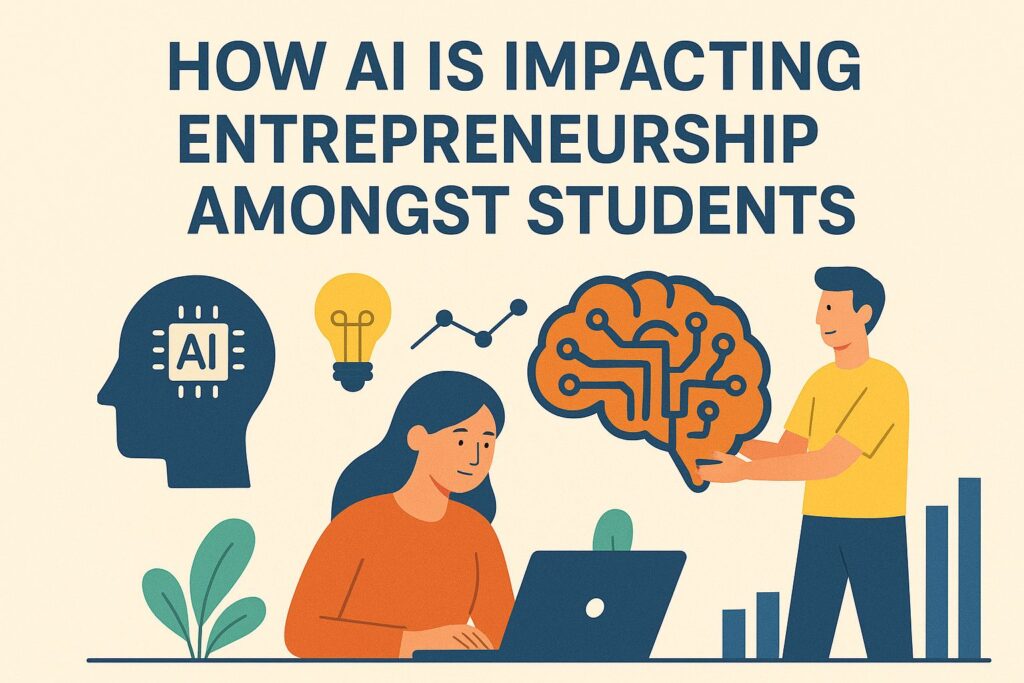
Artificial intelligence is reshaping the world of business—and students are at the center of this transformation. Across campuses, AI has become more than a buzzword; it’s a powerful tool that is influencing how young founders think, build, and scale their ideas. From ideation to execution, today’s student entrepreneurs are using AI to unlock possibilities that were unimaginable even a few years ago.
1. Lowering the Barriers to Starting Up
AI tools have dramatically reduced the cost, effort, and time required to start a venture. This decentralization means students and young entrepreneurs everywhere now have access to opportunities that were once location-dependent.
Students can now:
•Validate ideas using AI-driven market research
•Build prototypes without coding
•Create professional branding and marketing assets in minutes
•Automate repetitive tasks like customer support or scheduling
What once required teams and budgets can often be done by a single student with the right AI tools.
2. Rise of Student Entrepreneurship
AI is enabling students from diverse backgrounds—commerce, arts, humanities, science—to start technology-enabled companies.
No-code and low-code tools powered by AI allow anyone to:
• Build apps
• Create websites
• Launch e-commerce platforms
• Develop chatbots
• Analyze data
This democratization of technology means entrepreneurial potential is no longer limited to computer science majors.
3. Accelerating Innovation & Experimentation
Students can experiment faster than ever.
AI helps them:
• Test multiple versions of product ideas
• Simulate business models
• Forecast market demand
• Generate user personas
• Predict customer behavior
Fast experimentation encourages risk-taking, creativity, and bold innovation—key traits of successful entrepreneurship.
4. Enhancing Learning & Skill-Building
AI-powered learning tools are helping students upskill rapidly. Personalized recommendations, on-demand explanations, and interactive learning paths make it easier for aspiring founders to master skills like:
• Product design
• Finance
• Marketing
• Coding
• Data analytics
This accelerated learning curve enables students to become well-rounded founders much earlier in their journey.
5. Boosting Campus Innovation Ecosystems
University incubators and startup cells are increasingly integrating AI-driven platforms for:
• Matchmaking founders with mentors
• Screening startup applications
• Tracking progress and KPIs
• Delivering personalized training
• Supporting incubation and acceleration programmes
This makes the entrepreneurial ecosystem more efficient, structured, and founder-friendly.
6. Creating New Startup Opportunities
AI is not just a tool—it’s a sector bursting with opportunity.
Students are building innovative solutions in:
• Generative AI
• AI-driven healthcare
• Edtech automation
• Agritech intelligence
• Fintech fraud detection
• Smart mobility
• Robotics and embedded AI
The availability of open-source models, APIs, and democratized AI platforms is empowering even small student teams to build high-impact solutions.
7. Enabling Global-Scale Ambitions
AI gives student-led startups the ability to think global from day one.
They can target international customers, automate operations, and scale without needing large teams.
For the first time, students sitting in a campus hostel can build a product that competes globally
A New Era of Student Entrepreneurship
AI is rewriting the rules of who can become an entrepreneur and how quickly they can build something meaningful. It’s empowering students with the confidence, resources, and creativity to pursue bold ideas—often while still in college.
For incubators, this means supporting a generation of founders who are faster, more innovative, and more globally connected than ever before.
AI isn’t just impacting student entrepreneurship—it’s accelerating it. And the next big startup may already be forming on a laptop in your classroom or dorm.
By Varadarajan Krishna, Former Corporate Executive and Global Serial Tech Entrepreneur with multiple exits.